Client Portal Software or monday.com? How to Give Clients a View Without Exposing Your Board
Client portal software or monday.com? Compare guest access, shared views and portal apps, what clients should never see, and how guests are billed by plan.

A CRM for agencies has three jobs a standard sales CRM does not: tracking pitches (including what they cost you), treating retainers and upsell as pipeline, and handing a won pitch to delivery without anyone retyping the brief. The third job decides your margin. Most agencies can survive a messy pitch list; they cannot survive a delivery team that starts work without seeing what was promised. monday CRM fits well when your delivery already runs on monday.com. HubSpot or Pipedrive can be the better choice in specific cases, covered below. If you want a second opinion on your own setup, that is what our monday.com consultancy is for.
A sales CRM assumes a straight line: lead, qualify, propose, close. Agencies do not sell like that. If you run a broader professional services firm, our guide to choosing a CRM for a service business covers the general deal-to-project problem. Agencies have three twists on it.
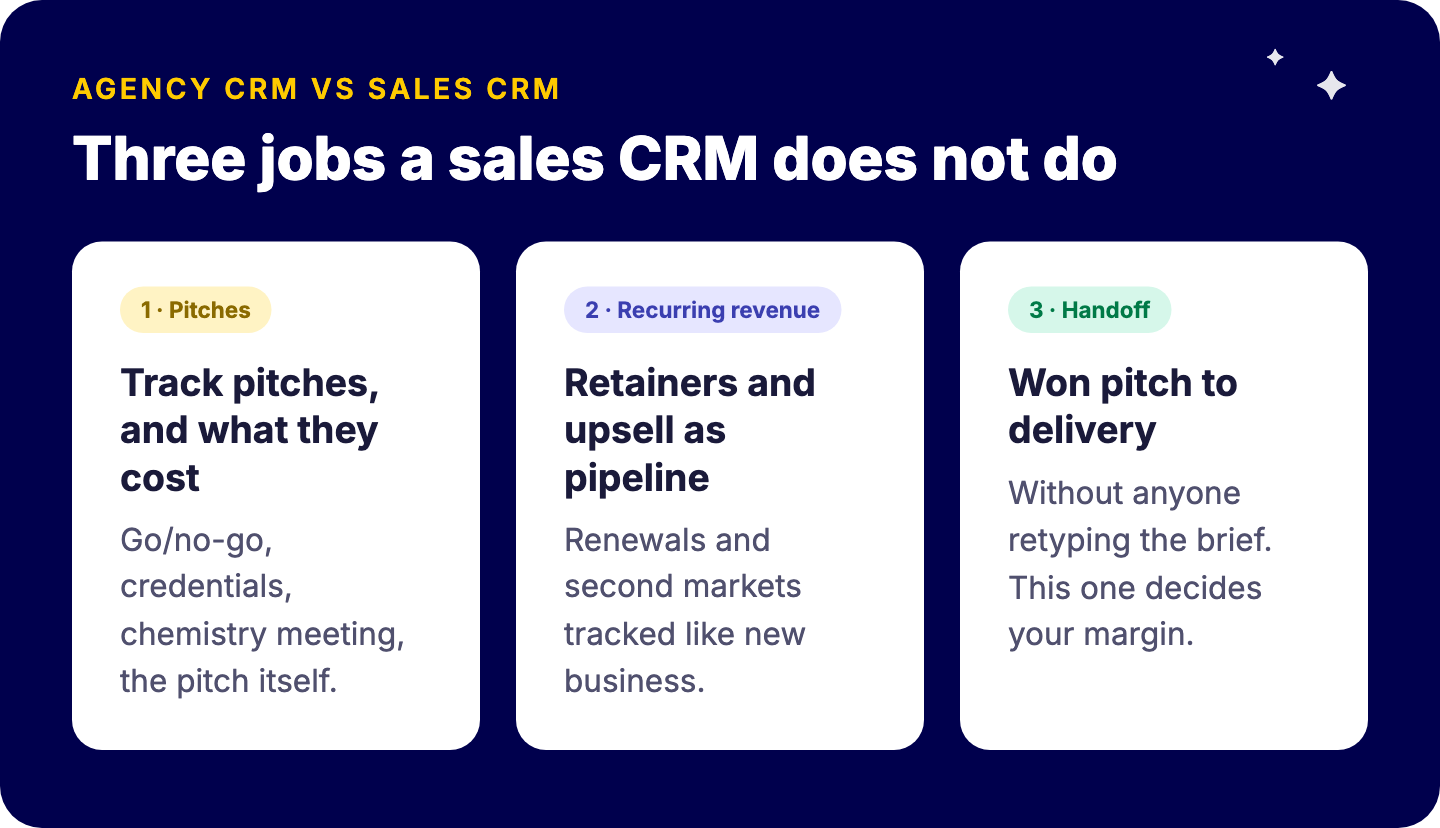
A pitch has stages a sales deal does not: the RFP or brief arrives, you decide whether to pitch at all, you send credentials, there may be a chemistry meeting, then the pitch itself. The go/no-go decision is the most valuable moment in the whole process, and most spreadsheets do not record it.
A pitch also costs real money before anything is won. Strategy, creative concepts and senior time go into work the client may never pay for. A CRM that treats a pitch as “a deal in stage 3” hides that cost.
For many agencies, most revenue comes from clients you already have. Retainers renew. Projects grow into retainers. A campaign client asks for a second market. That is pipeline, and it is usually more predictable than new business, but it rarely gets tracked like pipeline.
Because the people who win the work are not the people who do it. The pitch team made promises in a room: a senior strategist on the account, three concepts instead of two, a launch before a trade show. Delivery gets a signed contract and a kickoff invite. The gap between those two is where scope creeps in, write-offs happen and clients feel the “B team” arrived.
When a pitch is won, these should move from the CRM record into the delivery project automatically:
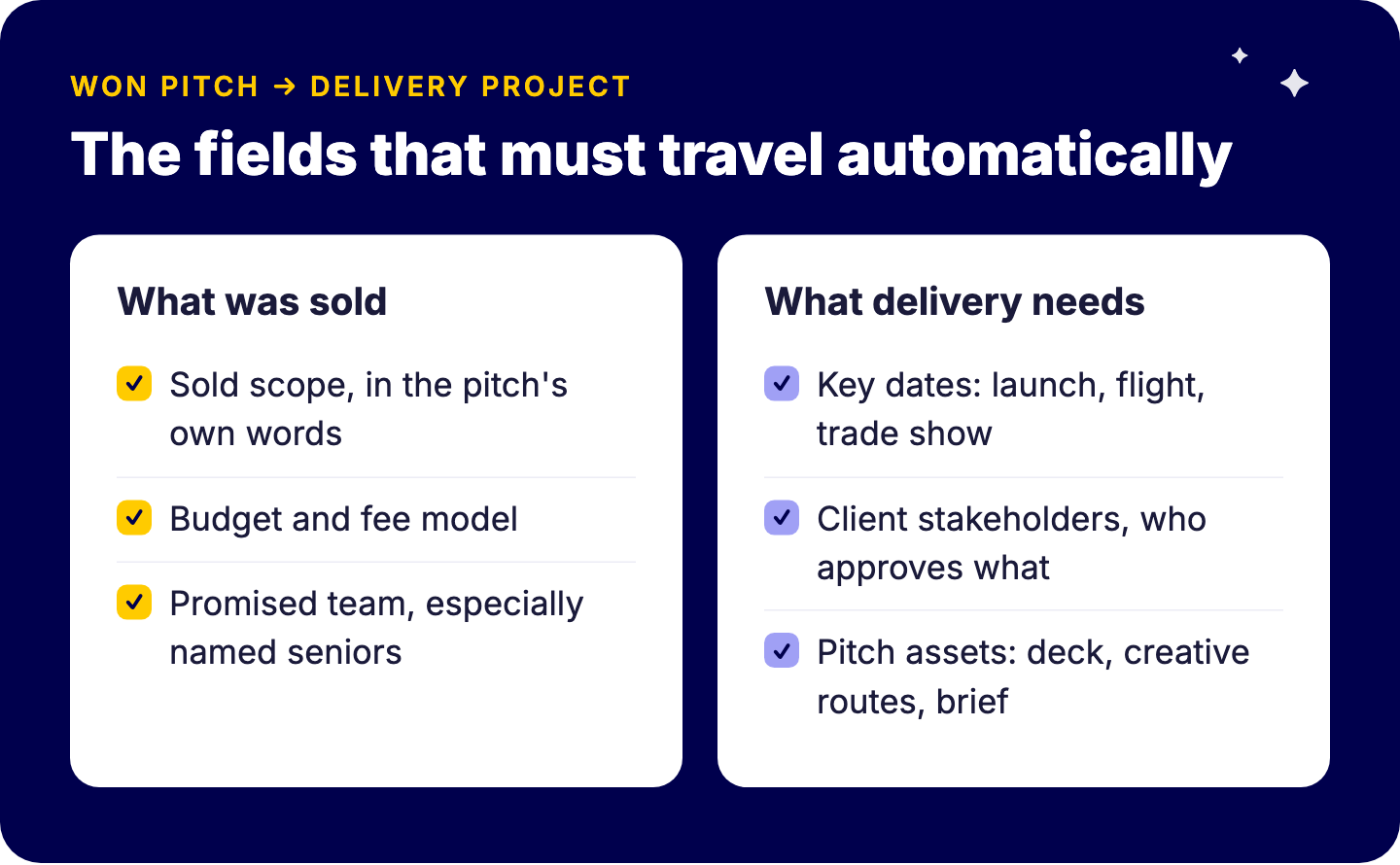
If any of these has to be copied by hand, it will eventually be copied wrong.
On monday.com, the pattern is simple. When a deal moves to “Won”, an automation creates the project on the delivery board, linked to the same client account, with the fields above carried across. The project starts from a template for that type of work, and dates are set from the kickoff or launch date.
Trademart, an in-house marketing team rather than an agency, uses the same template logic that agencies need at kickoff. They built custom templates per event type with Tryve, and with monday.com’s Lead & Lag feature, entering the event date schedules all related tasks automatically. Swap “event” for “campaign” or “website build” and you have an agency kickoff that does not depend on someone’s memory. For how agencies structure the delivery side itself, see our guide on running agency delivery on monday.com.
One sales pipeline view, with the deal type as a column: new business pitch, retainer renewal, upsell. That way the managing director sees all expected revenue in one place, and each type can still have its own stages.
A workable agency pitch pipeline:
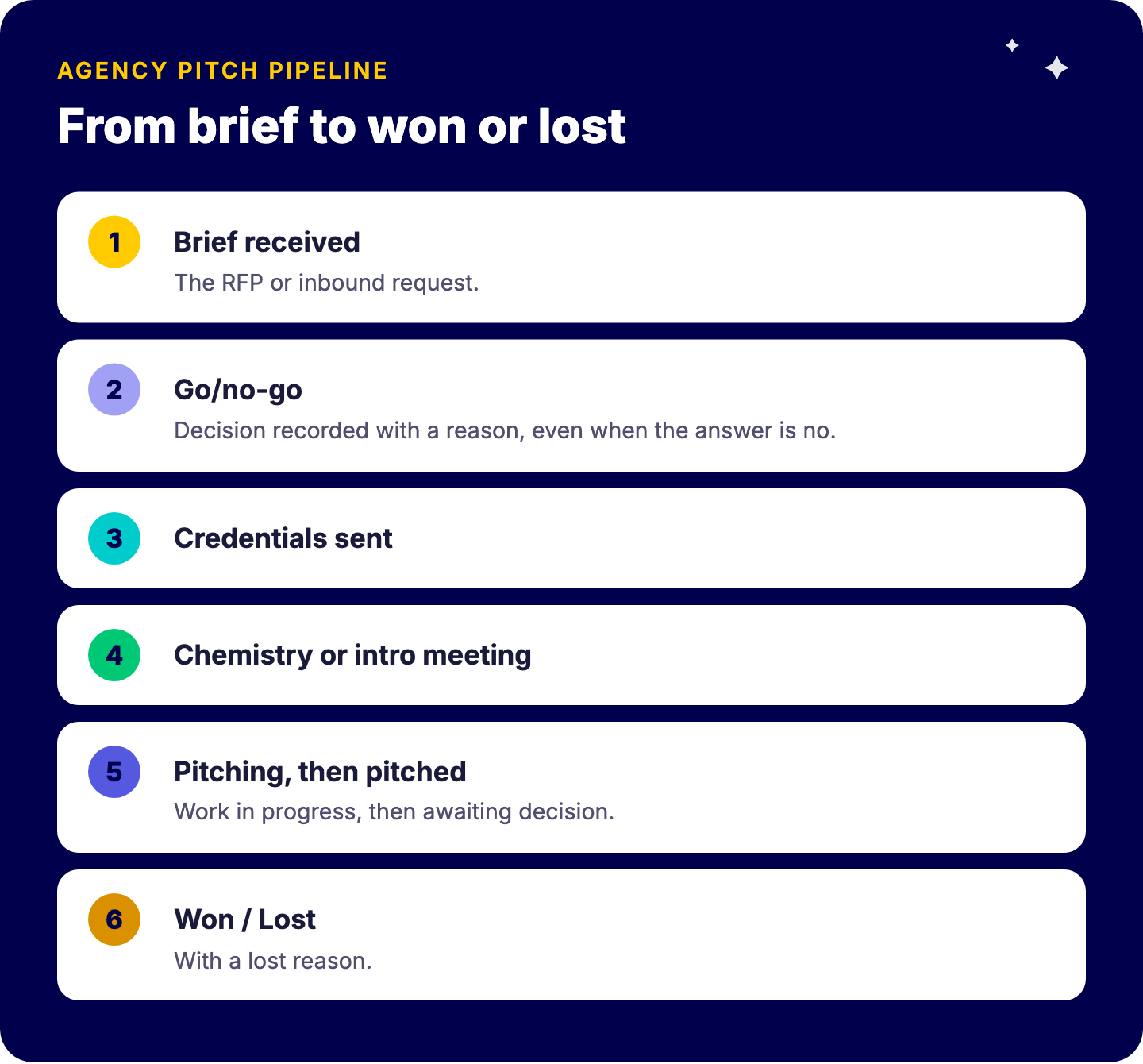
The “no-go” and “lost reason” columns are the ones that make you smarter over time. Without them you only learn what you won.
Add two number columns: estimated pitch hours at the go/no-go stage, and actual hours after the pitch. You do not need a timesheet system; a rough actual from the pitch lead is enough. After a year, group by pitch type and lead source. You will see which kinds of pitches you tend to win, and which ones you mostly fund for a competitor.
Every retainer gets an end date and a value on the account. An automation creates a renewal deal a fixed period before the end date, assigned to the account lead. The renewal then sits in the same pipeline as new business, with the same forecast logic.
This is customer lifecycle thinking applied to agencies: the relationship does not end at signature, and neither should the pipeline. Upsell ideas from delivery (“the client asked about a second market”) should become deals, not comments in a status meeting.
This depends on where your delivery runs, not on feature lists.
monday CRM fits when your delivery already runs on monday.com, or will. monday CRM is a separate product from monday.com work management, but both can sit in one account with boards connected across them. That is what makes the handoff automatic: the deal, the client account and the project reference the same record. monday CRM comes with Leads, Contacts, Accounts, Deals and Activities boards, and pipelines are customizable, so the pitch stages above are configuration, not development.
HubSpot can be better when your agency sells and runs inbound marketing, and your clients’ campaigns already live in HubSpot. Keeping your own CRM on the same platform you sell and operate every day has real value. The trade-off is that delivery on a different tool brings the handoff gap back.
Pipedrive can be enough when you are a small team that only needs a clean, simple sales pipeline, and delivery is small enough that the handoff is a conversation between two people.
Two plan points to check before you decide:
A CRM built around how agencies win and keep work: pitches with a go/no-go decision, retainers and renewals as recurring pipeline, and a handoff that carries the won brief into delivery.
The one that connects to where your delivery runs. If delivery is on monday.com, monday CRM avoids a second system. If you sell and run inbound marketing on HubSpot, HubSpot is a strong option. A small team that only needs a simple sales pipeline may be fine with Pipedrive.
Yes. Each retainer should carry its renewal date and value, and each upcoming renewal should appear in the pipeline as a deal to win again, well before the date.
Yes. monday CRM and monday.com work management are separate products that can sit in the same account, and boards across them can be connected. That is what lets a won deal create the delivery project without retyping. Check the current product and pricing setup for your account.
Record estimated hours at the go/no-go decision and a rough actual after the pitch. Compare those against outcomes by pitch type and lead source. That is enough to see which pitches you should stop doing.
Bring your pitch spreadsheet and your last won pitch. In one call we will map what happened between “won” and kickoff, which fields got lost, and what a connected pipeline and delivery setup would look like on monday.com. If HubSpot or Pipedrive fits your agency better, we will tell you that too.
Book a free intro call with Tryve.
Tryve is a monday.com Platinum Partner. Every engagement starts with a structured discovery session built around your actual processes, not a generic template. Senior consultants stay involved through adoption, not just go-live. Book a free intro call.