Client Portal Software or monday.com? How to Give Clients a View Without Exposing Your Board
Client portal software or monday.com? Compare guest access, shared views and portal apps, what clients should never see, and how guests are billed by plan.

A CRM for construction is a bid register before it is a contact list. It tracks every tender invitation and quote request from the moment it arrives to the moment the contract is signed or lost: the go or no-go decision, the submission deadline, who is pricing which part, each quote version and the outcome. Then it hands the won job to the project team with everything sales promised. Knowing your clients’ phone numbers is the easy part. If your bids live in Excel and an estimator’s inbox, the bid register is what you are missing.
Most CRM products are designed around a sales rep booking demos and closing within a quarter. Construction, installation and fit-out companies win work differently:
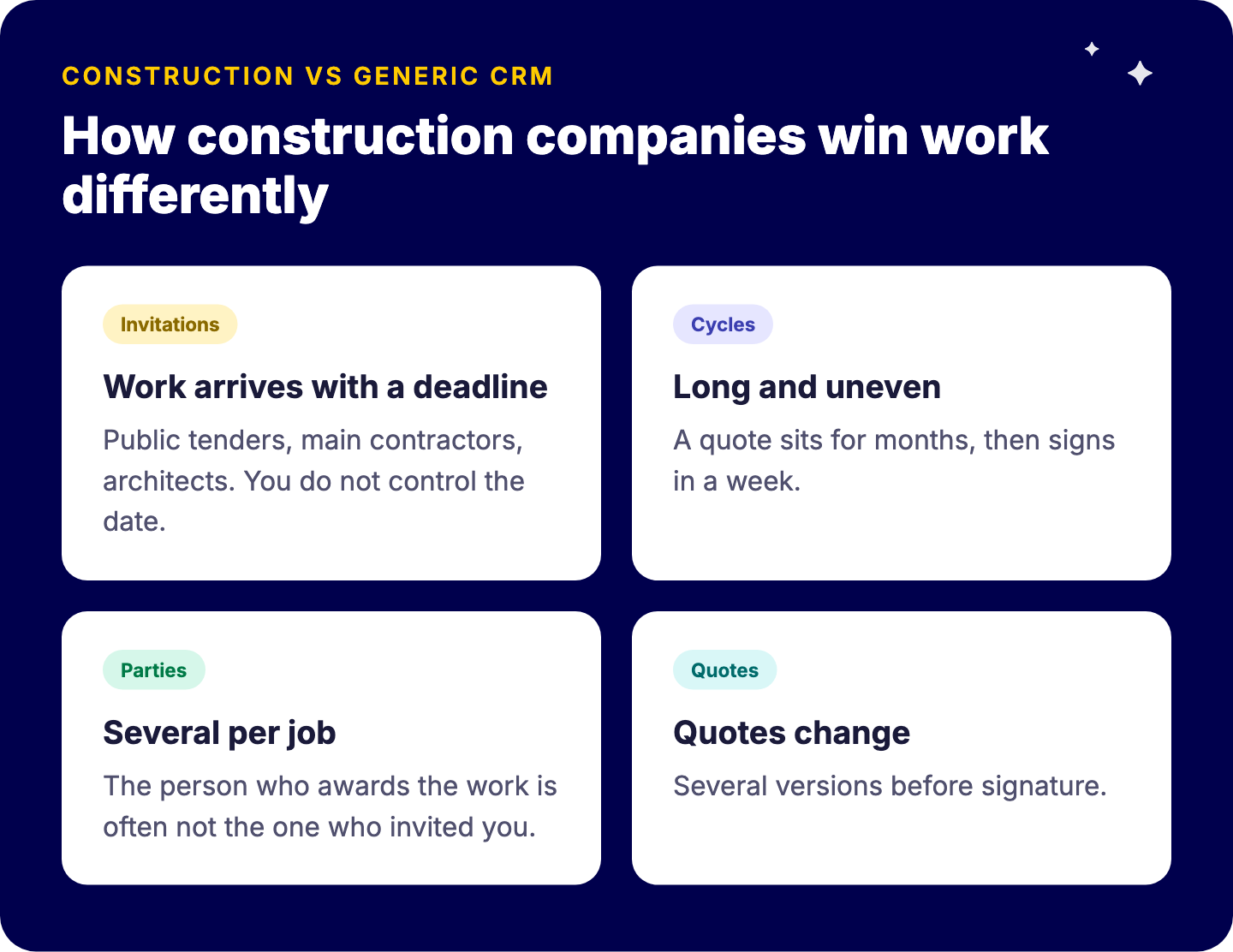
None of this is exotic. It just means the CRM has to be configured around bids, not around generic SaaS stages. That design work is what a monday.com consultancy engagement should settle before anyone builds a board.
This article covers the commercial side, before the contract. For what happens after, see our guide to running construction projects on monday.com.
Start with a sales pipeline that matches how you actually win work.
| Stage | What it means | What must be filled in |
|---|---|---|
| Invitation received | Tender or quote request logged | Source, client, deadline, documents link |
| Bid/no-bid | Go decision taken | Decision, reason, decision maker |
| Pricing | Estimate in progress | Estimator, internal deadline, site visit date |
| Clarifications | Questions to the buyer open | Questions sent, answers received |
| Submitted | Bid or quote sent | Version, value, submission date |
| Negotiation | Client reviewing, revisions requested | Latest version, next action date |
| Won / Lost | Outcome recorded | Award date, value, loss reason |
In Europe, public contracts above the EU thresholds are published in the Supplement to the Official Journal of the EU, available on TED (Tenders Electronic Daily). Since October 2023, those notices use the eForms standard. Below the thresholds, buyers publish on national portals, such as TenderNed in the Netherlands or BOAMP in France.
The procedure also has fixed mechanics. Bidders declare their suitability through the European Single Procurement Document (ESPD), and as a rule only the winning bidder has to supply the supporting certificates, although the buyer can ask any bidder for them during the procedure. For the open procedure, Directive 2014/24/EU sets a minimum of 35 days from dispatch of the contract notice to receive tenders, which can be shortened in defined cases, for example after a prior information notice.
Your CRM does not replace any of this, and it should not try. It holds your side: the notice reference, your go decision, the internal deadline (set days before the portal deadline), the ESPD and certificate status, and the result.
Every bid you price costs estimator time. A bid/no-bid stage forces a decision before that time is spent. Record a short, consistent set of go criteria per opportunity:
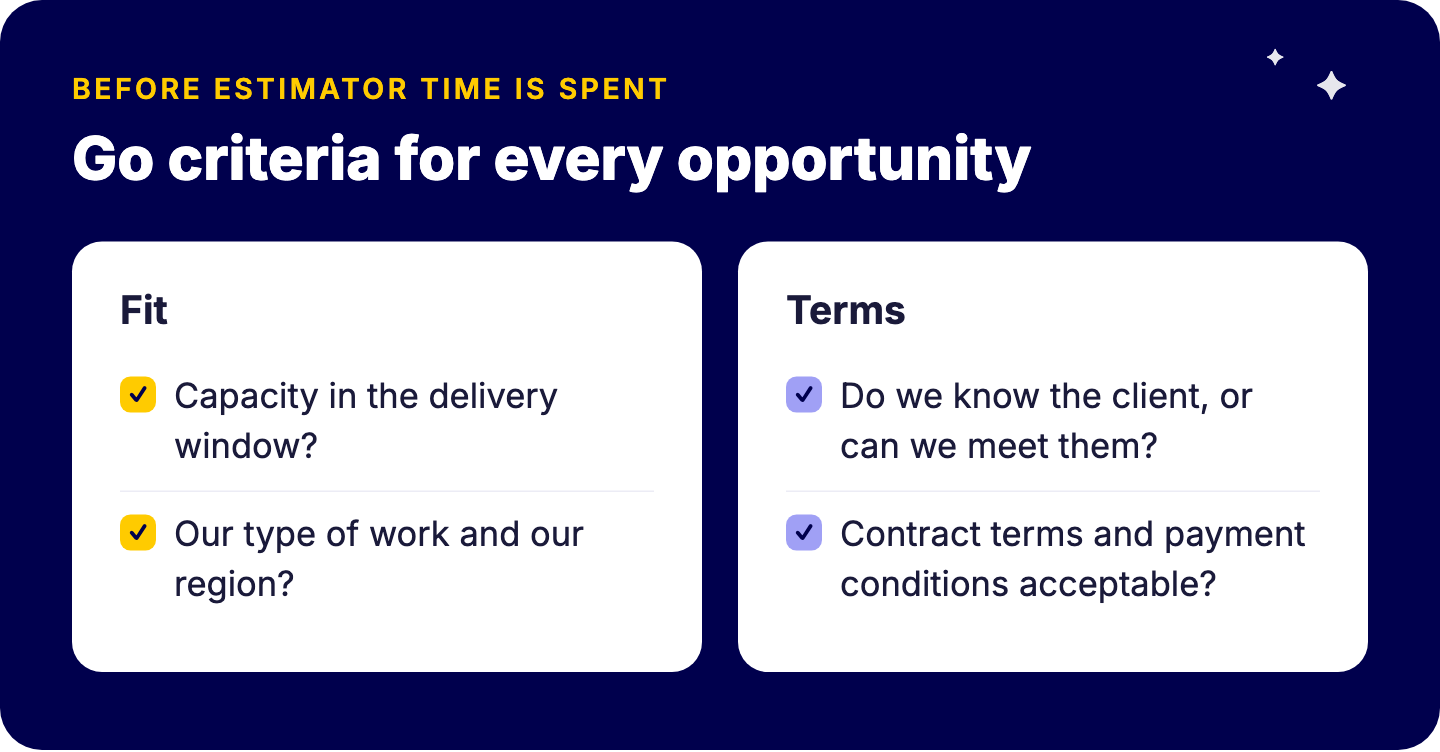
Over time, the decisions and outcomes on this stage show which kinds of bids you actually win. That is information no spreadsheet of past quotes gives you.
In Excel, version five overwrites version three. In a CRM, give each version its own item linked to the deal, with value, date, file and a line on what changed. The deal always shows the latest version, and the history stays. monday CRM also has a built-in Quotes & Invoices feature for generating quote documents, with a monthly document limit that depends on the plan. See what monday CRM costs before you size it.
The handoff is where construction companies lose the most, because the estimator knows what was excluded and the project manager does not. The won bid should create the project, not an email.
On monday.com, a status change on the deal can create a project board from your template for that job type. Connect that board to the client, the site and the commercial terms, and make sure the priced scope, exclusions, payment schedule and the latest quote version reach it. If the job includes installation or service visits, the same won deal can feed the planning you use for scheduling installation and service crews.
Standmark, a builder of exhibition stands and interiors delivering over 250 stands a year, runs its projects on monday.com with a similar structure. Each project is linked to its core data (the client, the venue and the event organizer) and starts from a template based on its type. Deposits, final payments and extras are recorded per project, so nothing is missed when the accounting team issues invoices.
Be honest about what you need. Construction-specific platforms are strong where monday CRM is not trying to compete.
| Need | Configured monday CRM | Construction-specific software |
|---|---|---|
| Bid register with deadlines and outcomes | Yes, with custom stages | Yes |
| Quote versions and history | Yes, as linked records | Yes, often native |
| Takeoffs and integrated estimating | No, keep your estimating tool | Often native |
| Inviting subcontractors to bid, bid leveling | Not built for it | Core feature of bid management tools |
| Handoff to your own project delivery | Same platform as delivery | Depends on the vendor’s suite |
| Configuration to your process | Very high | Lower, more opinionated |
Choose a construction-specific tool if you run bid packages out to many subcontractors and want a bid network with leveling (the job tools such as Procore’s bid management or Autodesk BuildingConnected are built for), if you need takeoffs integrated with estimating, or if your clients mandate a platform.
Choose a configured monday CRM if your pain is visibility of bids, missed deadlines, lost quote versions and a broken handoff, and your delivery team already runs, or could run, on monday.com. One platform from invitation to closeout beats two tools and a spreadsheet in between.
Do not migrate everything. Migrate what drives decisions.
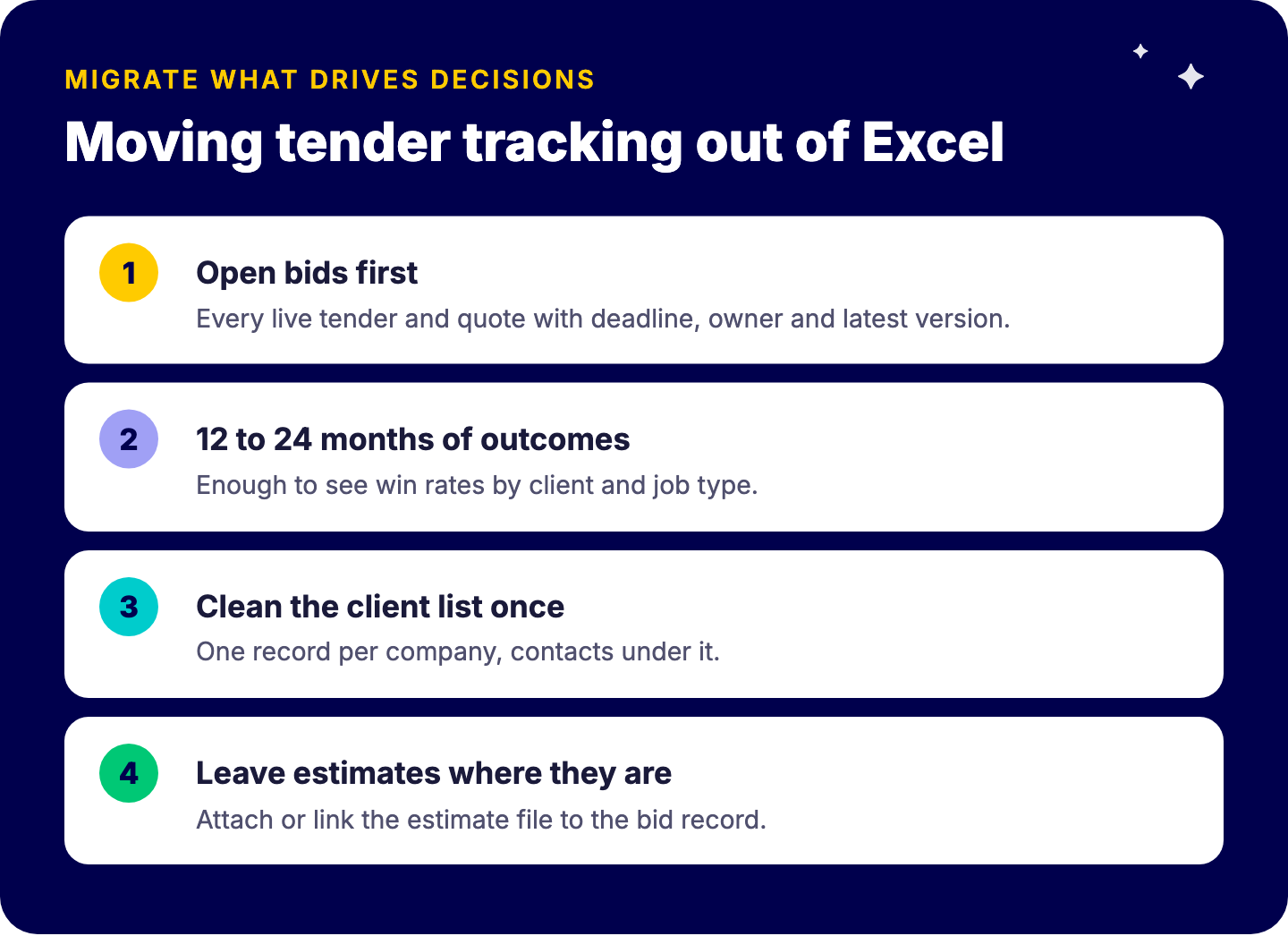
Our guide on migrating from spreadsheets covers the mechanics.
A CRM configured for how construction, installation and fit-out companies win work: tender invitations and quote requests, bid/no-bid decisions, submission deadlines, quote versions, long follow-up cycles and the handoff from won bid to project. Contact management is the smallest part of it.
It can track your side of them. Notices and submissions stay on TED and national procurement portals. The CRM records the opportunity, your go decision, internal deadlines, who prices which part, the version you submitted and the award result.
Yes, for the commercial side, when it is configured with construction stages and linked to project delivery. It is not an estimating or takeoff tool, so estimates stay in your estimating software and are attached to the bid record.
When you need integrated takeoffs and estimating, when you run bid packages out to many subcontractors and want a bid network with bid leveling, or when your clients mandate a specific platform. In those cases a specialist tool fits better than a configured general CRM.
The won bid should trigger the project. On monday.com, a status change on the deal can create a project board from a template, which you then connect to the client, the site and the commercial terms, so the project team starts from what was actually sold.
If your tenders and quotes live in Excel, the first decision is not the tool. It is your stages, your go criteria and what the handoff must carry. We can map that with you and tell you honestly whether monday CRM or a construction-specific tool fits your business better.
Book a free intro call with Tryve
Tryve is a monday.com Platinum Partner. Every engagement starts with a structured discovery session built around your actual processes, not a generic template. Senior consultants stay involved through adoption, not just go-live. Book a free intro call.