Client Portal Software or monday.com? How to Give Clients a View Without Exposing Your Board
Client portal software or monday.com? Compare guest access, shared views and portal apps, what clients should never see, and how guests are billed by plan.

monday CRM pricing is per seat, per month, across four plans: Basic, Standard, Pro and Ultimate, with a minimum of three seats. At the time of writing, monday.com lists Basic at 12 euros, Standard at 17 euros and Pro at 28 euros per seat per month on annual billing, while Ultimate is quote-based. For a 10-seat sales team on annual billing, that is roughly 1,440 euros a year on Basic, 2,040 euros on Standard and 3,360 euros on Pro, before VAT. The real decision is not the price per seat. It is which plan limits your process will hit in month three.
This guide walks through the plans the way a CRM implementer looks at them: what breaks first, what you can live without, and what the license does not cover. If you want the build itself handled, that is what our monday.com implementation service does for sales teams.
Prices below come from monday.com’s CRM pricing page in September 2026, in euros, per seat per month. Always check monday.com/crm/pricing before you buy, because monday.com updates plans and prices regularly.
| Plan | Annual billing | Monthly billing | Best for |
|---|---|---|---|
| Basic | 12 euros | 18 euros | A small team replacing a spreadsheet pipeline |
| Standard | 17 euros | 25 euros | Teams that need automations, AI and mobile apps |
| Pro | 28 euros | 41 euros | Sales teams running sequences, forecasting and many dashboards |
| Ultimate | Quote | Quote | Larger organizations with governance and security needs |
All plans have a three-seat minimum, and annual billing is about a third cheaper than monthly at list price.
Here is the list-price math for 10 seats, excluding VAT:
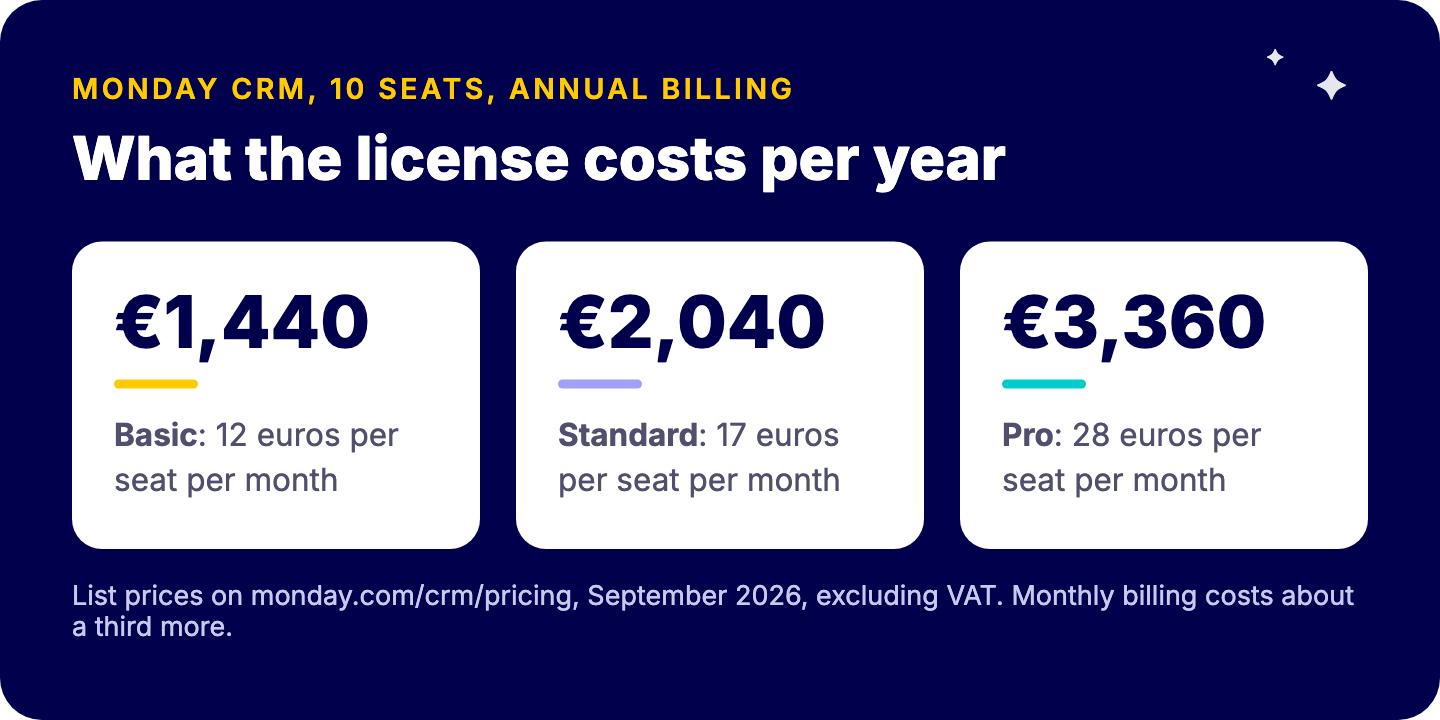
| Plan | Annual billing (10 seats x 12 months) | Monthly billing (10 seats x 12 months) |
|---|---|---|
| Basic | 1,440 euros | 2,160 euros |
| Standard | 2,040 euros | 3,000 euros |
| Pro | 3,360 euros | 4,920 euros |
Two practical notes. First, monday.com sells seats in fixed bundles rather than one at a time, so a team of 11 may pay for a larger bundle. Second, the difference between Standard and Pro for 10 people is about 1,320 euros a year. That is often less than one week of a salesperson’s time lost to manual follow-ups, which is the right way to frame the decision.
In practice, teams rarely upgrade for a shiny feature. They upgrade because they hit a ceiling. These are the limits listed per plan at the time of writing:
| Limit | Basic | Standard | Pro |
|---|---|---|---|
| Active contacts and deals | 1,000 | 10,000 | 100,000 |
| Custom automations per month | Not listed | 250 | 25,000 |
| Custom dashboards | 1 | 5 | 50 |
| Quotes and invoices per month | 20 | 50 | 250 |
| Columns per board | 5 | 15 | 75 |
| Mass email and email sequences | No | No | Yes |
| AI credits | Not included | Included | Included |
What this means in practice:
A simple rule of thumb from rollout work:
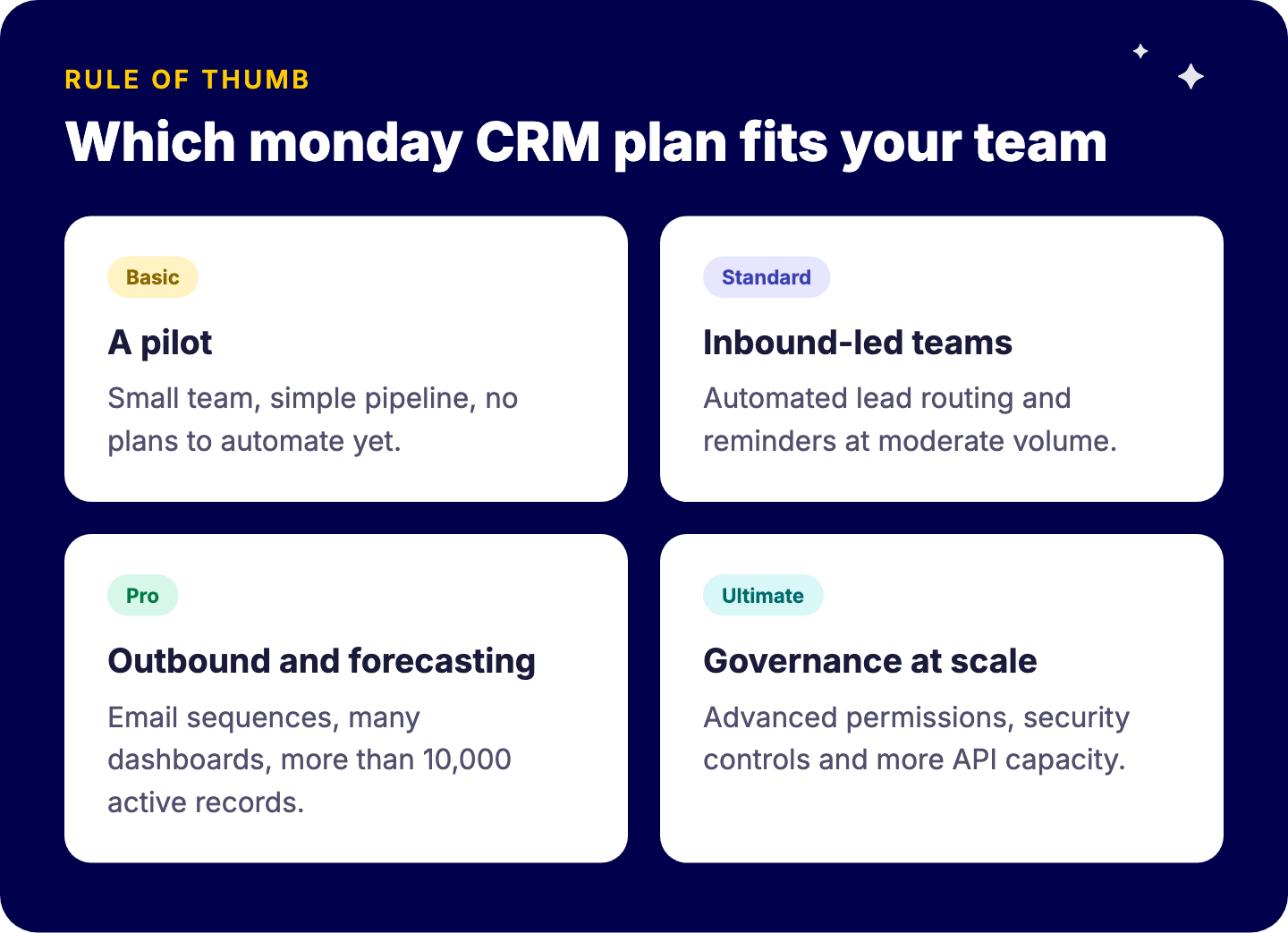
A common and sensible pattern is to start on Standard with a clear list of triggers for moving to Pro, rather than overbuying on day one.
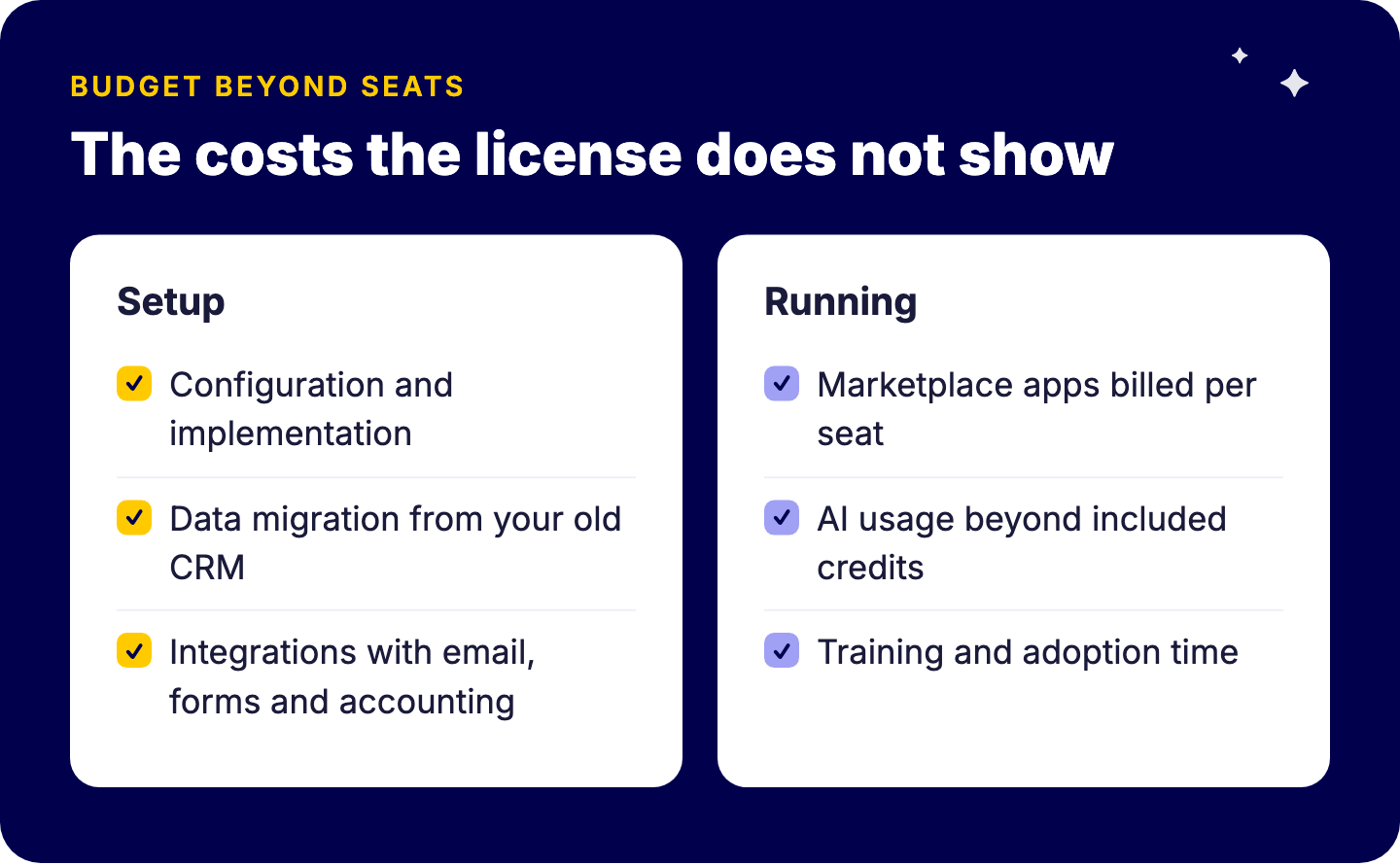
This is where budgets go wrong. The license is the visible cost; these are the ones that decide your return:
For a practical walkthrough of the build, our monday CRM implementation guide covers structure and rollout order.
For most mid-market B2B teams, the per-seat list price is lower than the enterprise CRMs, and the platform is easier to adapt to how your team sells. The honest caveat: that flexibility is also the risk. monday CRM is a platform, not a finished solution. A well-configured Standard plan beats a badly configured Pro plan every time.
That is why we judge success on adoption and pipeline outcomes, not boards built. When 123inkt switched from Asana, the scope was a setup for three teams managing about 100 projects a year, and license optimization was part of the work, not an afterthought. Learn more about how we approach monday CRM.
At the time of writing: Basic 12 euros, Standard 17 euros, Pro 28 euros per seat per month on annual billing, three-seat minimum. Ultimate is quote-based.
Standard or Pro. Pro once you need sequences, mass email, more than 250 automations a month or more than 10,000 active records.
Than Salesforce, yes: Sales Cloud starts at 25 euros per user per month and its Pro Suite is 100 euros. Than HubSpot, at the comparable tiers: Sales Hub Professional starts at $90 per seat, although HubSpot’s Starter tier is cheaper than monday CRM Basic. Compare total cost of ownership, including implementation and adoption.
Implementation, migration, apps, extra AI credits, integrations and internal training time.
Choosing a tier is easier when someone has mapped your process against the limits first. We do that in a short scoping session and tell you honestly when a lower plan is enough. Book a free intro call with Tryve.